Licensing
Notions théoriques liées au licencing des différents produits.
- Licensing Microsoft - Modèle général
- Licensing Microsoft - Windows Server
- Windows - Liste des clés KMS
Licensing Microsoft - Modèle général
 |
Difficulté : Débutant Notions : Licensing Microsoft, types de licences. |
Cette fiche est complémentaire avec : Licensing Microsoft - Windows Server
I. Les Licences OEM
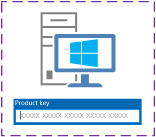
Il s’agit de la licence la plus courante. Celle dont dispose l’ensemble des machines vendue dans le commerce. Dans ce modèle, la licence est attachée à la machine et à usage unique.
La machine est fournie à l’utilisateur activée.
La licence est indissociable du matériel. Si le Poste est remplacé où mis au rebut, la licence est perdue avec.
L’utilisateur peut ainsi, par exemple, restaurer ou formater sa machine et conserver sa licence. Mais si il souhaite changer de machine sa licence ne pourra pas être transférée.
II. Les licences Retail
Le second modèle dit des licence de revente présente un avantage certain pour les particuliers et entreprises soucieuse de gérer un parc de licences.
En effet, dans ce modèle la licence est acheté indépendamment du matériel.
Il y a deux types de licence dans cette catégorie :
-
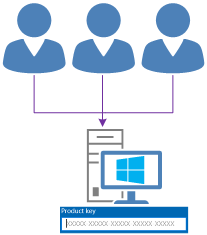
la licence par poste : une licence est liée à un poste et ce poste peut être utilisé indifféremment par un nombre illimité d’utilisateur. La licence retail est indépendante du matériel et ne doit être que sur une machine à la fois. Mais contrairement à la licence OEM, celle-ci peut être transféré d’une machine à une autre. Sous réserve de désactiver l’ancienne.
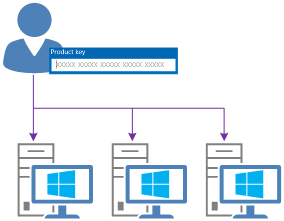
- La licence par utilisateur : la licence est liée à l’utilisateur et non plus à la machine. L’usage lui en est donc réservé, mais elle est valide peu importe le nombre de machine que l’utilisateur possède. Pour un particulier ou un utilisateur ayant plusieurs postes, c’est le modèle le plus avantageux. Depuis Windows 10, cette licence peut être associée à un compte Microsoft. Et le fait de s’authentifier avec son compte Microsoft sur n’importe quelle machine active de facto celle-ci.
III. Les licences en volume
Ce modèle s’adresse d’avantage aux entreprises. Il s’agit de prendre un nombre défini de licences qui pourront être ensuite utilisées au sein d’une entreprise de manière complétement indépendante de son parc ou des salariés.
Le principal avantage de ce type d’acquisition, c’est qu’il ouvre le droit à l’utilisation des systèmes d’activation automatisés et qu’une entreprise peut désormais raisonner en pool de licence et affectation de celles-ci.
Pour l’activation, les clients nécessitent des clés spéciales dites “KMS Client”. Elles sont disponibles ici : Windows - Liste des clés KMS
Pour obtenir des licences en volume, il y a deux façon de procéder :
-
Achat d’un lot de licence : il s’agit de prendre en lot un nombre défini de licence chez un revendeur qui fera ici office de “grossiste”. Par ce biais, il est possible de prendre par exemple un lot de 100 licences qui pourra ensuite être étendu par l’achat de lots supplémentaires. L’acquisition de ces licences se fait également par machine ou par utilisateur. Dans ce modèle les licences peuvent être transférées de façon illimitée d’un poste à l’autre ou d’un utilisateur à l’autre. La seule contrainte est de ne pas dépasser le nombre d’utilisation simultanées autorisée par le pool de licence.
-
Contrat OPEN : Il s’agit d’un contrat ouvert chez Microsoft. Lorsqu’un contrat open est ouvert, Microsoft met a disposition un pool de licence à la demande du client. Le client pourra alors augmenter son pool de licence comme il le souhaite sans pour autant ré-ouvrir un nouveau contrat. En effet a l’inverse de l’achat en lot, ici le contrat couvre un pool et les extensions de pool seront rattachés au contrat existant.
IV. Licences additionnelles et CAL
Dans certains cas, en plus des licences de produits, son utilisation nécessitera des CAL ou “Client Access Licences”. Ces licences sont à acquérir en plus des licences produits pour le serveur.
Ce qui donne donc une licence pour le serveur et une CAL par utilisateur ou machine selon le modèle choisi. Sachant qu’il est possible de mixer les deux formules.
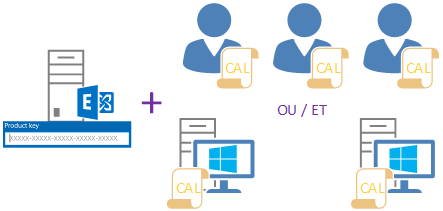
4.1 Active directory
Pour active directory, la fonctionnalité est comprise dans Windows Server et ne nécessite pas de licence serveur.
Il faut cependant, des cals machines et/ou utilisateurs.
La manière la plus simple est de prendre une CAL pour chaque utilisateur de domaine.
4.2 Exchange
Pour Exchange, il faut une licence serveur pour chaque serveur ou le produit est installé.
Plus une CAL par boite aux lettre utilisateur.
Les alias, boites partagées et comptes de services ne comptent pas et n’ont pas besoin de licences.
4.3 MS SQL Server
Pour SQL Server, il faut une licence serveur pour chaque serveur ou le produit est installé.
Il faut ensuite une CAL par utilisateur qui accède directement OU indirectement aux bases de données.
Ce qui signifie qu’en théorie, pour une application métier comptant 5 utilisateurs qui stocke ses données dans la base et les utilisent a travers un compte de service unique, il faut quand même 5 CAL Utilisateur.
Passé un certain nombre d’utilisateurs, il peut être plus rentable de passer a une licence par coeur de processeur.
V. Office 365
Concernant les licences Office365, la logique change radicalement. Il ne s’agit plus en effet de devenir propriétaire des licences, mais de louer un service.
Le service comprends un certain nombre de fonctionnalité disponibles individuellement pour chaque utilisateur en fonction de sa formule.
Acheter Microsoft 365 - Comparer les abonnements pour TPE/PME
Licensing Microsoft - Windows Server
|
Difficulté : Débutant Notions : Licensing Microsoft, windows server. |
Complète la documentation suivante : Licensing Microsoft - Modèle général
I. Présentation
Depuis windows 2016, le modèle de licence a changé pour s’adapter aux évolutions du marché.
En effet, avec la démocratisation de la virtualisation et par conséquent l’arrivée de microsoft Hyper-V, la virtualisation est devenu un standard de l’IT.
Il faut donc maintenant suivre le modèle de licencing suivant :
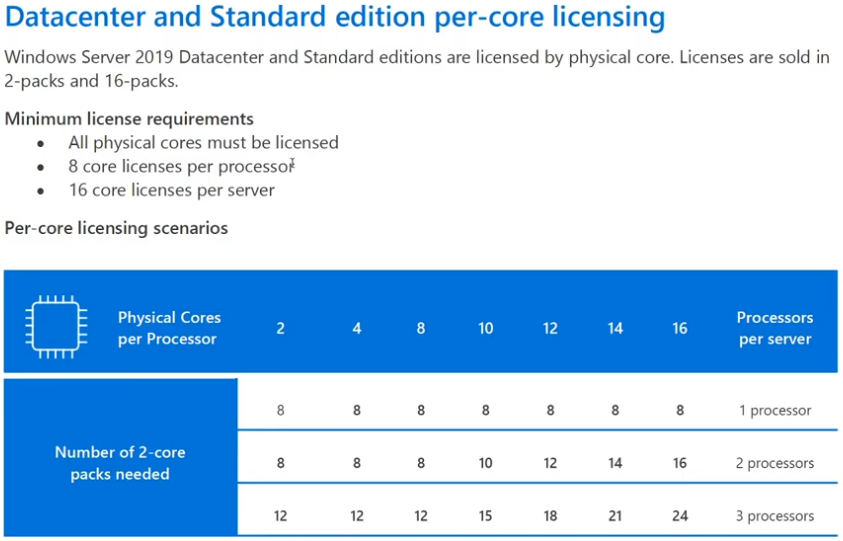
II. Explications
Les licences windows serveur sont des licences par coeur physique de processeur.
Windows serveur se décline désormais en deux éditions :
-
Standard : une licence standard est liée à un hôte physique et donne le droit a deux machines virtuelles sur cet hôte.
-
Datacenter : une licence datacenter est liée à un hôte physique et donne le droit à un nombre illimité de VM.
Les contraintes sont les suivantes :
Dans la mesure où le modèle de licence est prévu à la base pour Hyper-V. Une licence est installée sur l’hôte Hyper-V et sert a activer celui-ci, ainsi que 2 machines virtuelles sur cet hôte. Dans le cas de l’utilisation d’un autre hyperviseur (vmware, proxmox, etc…) la licence ne s’applique donc qu’au 2 machines virtuelles.
Il y a un seuil minimum de cœurs licenciés par hôte physique. Celui-ci est de 8 dans le cas d’une machine avec 1 ou 2 processeurs physiques et de 12 dans le cas d’une machine avec 3 processeurs physiques.
Les licences sont attachées à l’hôte physique. Aussi, il n’est pas possible d’avoir par exemple la même licence pour 2 VM qui fonctionneraient sur des hôtes physiques différents.
De la même manière, les coeurs couverts par les licences ne concernent que l’hôte physique qui les possède.
Si le nombre de cœurs physiques dépassent le seuil minimum, il faut acheter des packs d’extension de licence pour couvrir les cœurs supplémentaires. Ceux-ci sont sous la forme de packs de 2 cœurs.
Les cœurs virtuels (threads) ne comptent pas dans le calcul.
III. Exemples
Le principe n’étant pas facilement compréhensible, voici quelques exemples pour mieux comprendre.
Exemple 1 :
1 serveur avec 2 processeurs Xeon de 4 cœurs qui hébergera 4 machines virtuelles.
Dans cette situation : 1 serveur X 2 processeurs X 4 cœurs donc un total de 8 cœurs.
Une licence couvre 2 machines virtuelles donc 4VM / 2 = 2 packs de 8 cœurs.
-
Il me faut donc dans ce cas 2 packs de 8coeurs pour couvrir toutes mes machines.
Exemple 2 :
2 serveurs avec 2 processeurs Xeon de 6 cœurs qui hébergera 5 machines virtuelles.
Dans cette situation : il faut calculer par serveur. La distribution des machines se fera de la façon suivante :
-
Le premier hôte hébergera 3 machines
-
le second en hébergera deux.
Donc pour le premier hôte : 1 serveur X 2 processeurs X 6 cœurs donc un total de 12 coeurs. Il faut donc 1 “starter pack” de 8 cœurs + 2 extension pour 2 cœurs supplémentaires.
Il y a 3 machines. Une licence étant valable pour 2 machines, il faut donc multiplier les quantités par deux.
On a donc pour le serveur 1 : 2 pack de 8 + 4 pack de 2.
Pour le second hôte : 1 serveur X 2 processeurs X 6 cœurs donc un total de 12 cœurs. Il faut également un pack de 8 cœurs + deux extensions pour 2 cœurs supplémentaires. Il n’y a que 2 machines virtuelles sur ce serveur, donc : 1 pack de 8 + 2 pack de 2.
Au total, pour licencier tout le parc, il faut donc 3 packs de 8 et 6 packs de deux.
IV. Licences Datacenter
Comme vu plus haut, les licences Datacenter sont liées a une machine physique et ouvrent le droit à un nombre illimité de machines virtuelles sur ce serveur. Si l’on sait donc a l’avance que le nombre de machine risque d'être important, ou de varier énormément au cours du temps, cette licence est à envisager.
Cependant, elle est bien plus coûteuse qu’une licence standard. Aussi il est important de calculer au préalable le seuil de rentabilité d’une telle licence.
A titre d’exemple, pour un hôte physique classique ( 2 processeurs 4 cœurs ), il faut 10 machines virtuelles pour que la licence Datacenter soit rentable.
V. Conclusion
Ce modèle de licence est réellement compliqué à appréhender au premier abord. Mais cela viendra en pratiquant. Mais heureusement  :
:
Un calculateur de licence est disponible : Windows Server Licensing Calculator - WintelGuy.com
Windows - Liste des clés KMS
Ces clés KMS sont légales. Il s'agit de celles fournies par Microsoft pour l'activation des clients KMS en volume.
Ces clés seules ne suffisent pas à activer Windows. Elles indiquent au système qu'il sera un client activé par un serveur KMS.
Ces clés sont toutes utilisables dans le cadre d'un contrat de licence en volume.
Pour l’activation en volume, il faut fournir une clé spécifique au client. Dite clé de client KMS.
Voici la liste des clés :
Windows Server (LTSC versions)
Windows Server 2025
|
Windows Server 2025 |
|
|
Operating system edition |
KMS Client Product Key |
| Windows Server 2025 Standard | TVRH6-WHNXV-R9WG3-9XRFY-MY832 |
| Windows Server 2025 Datacenter | D764K-2NDRG-47T6Q-P8T8W-YP6DF |
| Windows Server 2025 Datacenter : Azure Edition | XGN3F-F394H-FD2MY-PP6FD-8MCRC |
Windows Server 2022
|
Windows Server 2022 |
|
|
Operating system edition |
KMS Client Product Key |
|
Windows Server 2022 Datacenter |
WX4NM-KYWYW-QJJR4-XV3QB-6VM33 |
|
Windows Server 2022 Standard |
VDYBN-27WPP-V4HQT-9VMD4-VMK7H |
Windows Server 2019
|
Windows Server 2019 |
|
|
Operating system edition |
KMS Client Product Key |
|
Windows Server 2019 Datacenter |
WMDGN-G9PQG-XVVXX-R3X43-63DFG |
|
Windows Server 2019 Standard |
N69G4-B89J2-4G8F4-WWYCC-J464C |
|
Windows Server 2019 Essentials |
WVDHN-86M7X-466P6-VHXV7-YY726 |
Windows Server 2016
|
Windows Server 2016 |
|
|
Operating system edition |
KMS Client Product Key |
|
Windows Server 2016 Datacenter |
CB7KF-BWN84-R7R2Y-793K2-8XDDG |
|
Windows Server 2016 Standard |
WC2BQ-8NRM3-FDDYY-2BFGV-KHKQY |
|
Windows Server 2016 Essentials |
JCKRF-N37P4-C2D82-9YXRT-4M63B |
Windows Server (Semi-Annual Channel versions)
Windows Server, versions 20H2, 2004, 1909, 1903, and 1809
|
Windows Server, versions 20H2, 2004, 1909, 1903, and 1809 |
|
|
Operating system edition |
KMS Client Product Key |
|
Windows Server Datacenter |
6NMRW-2C8FM-D24W7-TQWMY-CWH2D |
|
Windows Server Standard |
N2KJX-J94YW-TQVFB-DG9YT-724CC |
Windows 11 and Windows 10 (Semi-Annual Channel versions)
See the Windows lifecycle fact sheet for information about supported versions and end of service dates.
|
Windows 11 and Windows 10 (Semi-Annual Channel versions) |
|
|
Operating system edition |
KMS Client Product Key |
|
Windows 11 Pro |
W269N-WFGWX-YVC9B-4J6C9-T83GX |
|
Windows 11 Pro N |
MH37W-N47XK-V7XM9-C7227-GCQG9 |
|
Windows 11 Pro for Workstations |
NRG8B-VKK3Q-CXVCJ-9G2XF-6Q84J |
|
Windows 11 Pro for Workstations N |
9FNHH-K3HBT-3W4TD-6383H-6XYWF |
|
Windows 11 Pro Education |
6TP4R-GNPTD-KYYHQ-7B7DP-J447Y |
|
Windows 11 Pro Education N |
YVWGF-BXNMC-HTQYQ-CPQ99-66QFC |
|
Windows 11 Education |
NW6C2-QMPVW-D7KKK-3GKT6-VCFB2 |
|
Windows 11 Education N |
2WH4N-8QGBV-H22JP-CT43Q-MDWWJ |
|
Windows 11 Enterprise |
NPPR9-FWDCX-D2C8J-H872K-2YT43 |
|
Windows 11 Enterprise N |
DPH2V-TTNVB-4X9Q3-TJR4H-KHJW4 |
|
Windows 11 Enterprise G |
YYVX9-NTFWV-6MDM3-9PT4T-4M68B |
|
Windows 11 Enterprise G N |
44RPN-FTY23-9VTTB-MP9BX-T84FV |
Windows 10 (LTSC/LTSB versions)
Windows 10 LTSC 2021 and 2019
|
Windows 10 LTSC 2021 and 2019 |
|
|
Operating system edition |
KMS Client Product Key |
|
Windows 10 Enterprise LTSC 2021 |
M7XTQ-FN8P6-TTKYV-9D4CC-J462D |
|
Windows 10 Enterprise N LTSC 2021 |
92NFX-8DJQP-P6BBQ-THF9C-7CG2H |
Windows 10 LTSB 2016
|
Windows 10 LTSB 2016 |
|
|
Operating system edition |
KMS Client Product Key |
|
Windows 10 Enterprise LTSB 2016 |
DCPHK-NFMTC-H88MJ-PFHPY-QJ4BJ |
|
Windows 10 Enterprise N LTSB 2016 |
QFFDN-GRT3P-VKWWX-X7T3R-8B639 |
Windows 10 LTSB 2015
|
Windows 10 LTSB 2015 |
|
|
Operating system edition |
KMS Client Product Key |
|
Windows 10 Enterprise 2015 LTSB |
WNMTR-4C88C-JK8YV-HQ7T2-76DF9 |
|
Windows 10 Enterprise 2015 LTSB N |
2F77B-TNFGY-69QQF-B8YKP-D69TJ |
Earlier versions of Windows Server
Windows Server, version 1803
|
Windows Server, version 1803 |
|
|
Operating system edition |
KMS Client Product Key |
|
Windows Server Datacenter |
2HXDN-KRXHB-GPYC7-YCKFJ-7FVDG |
|
Windows Server Standard |
PTXN8-JFHJM-4WC78-MPCBR-9W4KR |
Windows Server, version 1709
|
Windows Server, version 1709 |
|
|
Operating system edition |
KMS Client Product Key |
|
Windows Server Datacenter |
6Y6KB-N82V8-D8CQV-23MJW-BWTG6 |
|
Windows Server Standard |
DPCNP-XQFKJ-BJF7R-FRC8D-GF6G4 |
Windows Server 2012 R2
|
Windows Server 2012 R2 |
|
|
Operating system edition |
KMS Client Product Key |
|
Windows Server 2012 R2 Standard |
D2N9P-3P6X9-2R39C-7RTCD-MDVJX |
|
Windows Server 2012 R2 Datacenter |
W3GGN-FT8W3-Y4M27-J84CP-Q3VJ9 |
|
Windows Server 2012 R2 Essentials |
KNC87-3J2TX-XB4WP-VCPJV-M4FWM |
Windows Server 2012
|
Windows Server 2012 |
|
|
Operating system edition |
KMS Client Product Key |
|
Windows Server 2012 |
BN3D2-R7TKB-3YPBD-8DRP2-27GG4 |
|
Windows Server 2012 N |
8N2M2-HWPGY-7PGT9-HGDD8-GVGGY |
|
Windows Server 2012 Single Language |
2WN2H-YGCQR-KFX6K-CD6TF-84YXQ |
|
Windows Server 2012 Country Specific |
4K36P-JN4VD-GDC6V-KDT89-DYFKP |
|
Windows Server 2012 Standard |
XC9B7-NBPP2-83J2H-RHMBY-92BT4 |
|
Windows Server 2012 MultiPoint Standard |
HM7DN-YVMH3-46JC3-XYTG7-CYQJJ |
|
Windows Server 2012 MultiPoint Premium |
XNH6W-2V9GX-RGJ4K-Y8X6F-QGJ2G |
|
Windows Server 2012 Datacenter |
48HP8-DN98B-MYWDG-T2DCC-8W83P |
Windows Server 2008 R2
|
Windows Server 2008 R2 |
|
|
Operating system edition |
KMS Client Product Key |
|
Windows Server 2008 R2 Web |
6TPJF-RBVHG-WBW2R-86QPH-6RTM4 |
|
Windows Server 2008 R2 HPC edition |
TT8MH-CG224-D3D7Q-498W2-9QCTX |
|
Windows Server 2008 R2 Standard |
YC6KT-GKW9T-YTKYR-T4X34-R7VHC |
|
Windows Server 2008 R2 Enterprise |
489J6-VHDMP-X63PK-3K798-CPX3Y |
|
Windows Server 2008 R2 Datacenter |
74YFP-3QFB3-KQT8W-PMXWJ-7M648 |
|
Windows Server 2008 R2 for Itanium-based Systems |
GT63C-RJFQ3-4GMB6-BRFB9-CB83V |
Windows Server 2008
|
Windows Server 2008 |
|
|
Operating system edition |
KMS Client Product Key |
|
Windows Web Server 2008 |
WYR28-R7TFJ-3X2YQ-YCY4H-M249D |
|
Windows Server 2008 Standard |
TM24T-X9RMF-VWXK6-X8JC9-BFGM2 |
|
Windows Server 2008 Standard without Hyper-V |
W7VD6-7JFBR-RX26B-YKQ3Y-6FFFJ |
|
Windows Server 2008 Enterprise |
YQGMW-MPWTJ-34KDK-48M3W-X4Q6V |
|
Windows Server 2008 Enterprise without Hyper-V |
39BXF-X8Q23-P2WWT-38T2F-G3FPG |
|
Windows Server 2008 HPC |
RCTX3-KWVHP-BR6TB-RB6DM-6X7HP |
|
Windows Server 2008 Datacenter |
7M67G-PC374-GR742-YH8V4-TCBY3 |
|
Windows Server 2008 Datacenter without Hyper-V |
22XQ2-VRXRG-P8D42-K34TD-G3QQC |
|
Windows Server 2008 for Itanium-Based Systems |
4DWFP-JF3DJ-B7DTH-78FJB-PDRHK |
Earlier versions of Windows
Windows 8.1
|
Windows 8.1 |
|
|
Operating system edition |
KMS Client Product Key |
|
Windows 8.1 Pro |
GCRJD-8NW9H-F2CDX-CCM8D-9D6T9 |
|
Windows 8.1 Pro N |
HMCNV-VVBFX-7HMBH-CTY9B-B4FXY |
|
Windows 8.1 Enterprise |
MHF9N-XY6XB-WVXMC-BTDCT-MKKG7 |
|
Windows 8.1 Enterprise N |
TT4HM-HN7YT-62K67-RGRQJ-JFFXW |
Windows 8
|
Windows 8 |
|
|
Operating system edition |
KMS Client Product Key |
|
Windows 8 Pro |
NG4HW-VH26C-733KW-K6F98-J8CK4 |
|
Windows 8 Pro N |
XCVCF-2NXM9-723PB-MHCB7-2RYQQ |
|
Windows 8 Enterprise |
32JNW-9KQ84-P47T8-D8GGY-CWCK7 |
|
Windows 8 Enterprise N |
JMNMF-RHW7P-DMY6X-RF3DR-X2BQT |
Windows 7
|
Windows 7 |
|
|
Operating system edition |
KMS Client Product Key |
|
Windows 7 Professional |
FJ82H-XT6CR-J8D7P-XQJJ2-GPDD4 |
|
Windows 7 Professional N |
MRPKT-YTG23-K7D7T-X2JMM-QY7MG |
|
Windows 7 Professional E |
W82YF-2Q76Y-63HXB-FGJG9-GF7QX |
|
Windows 7 Enterprise |
33PXH-7Y6KF-2VJC9-XBBR8-HVTHH |
|
Windows 7 Enterprise N |
YDRBP-3D83W-TY26F-D46B2-XCKRJ |
|
Windows 7 Enterprise E |
C29WB-22CC8-VJ326-GHFJW-H9DH4 |