
Sécurité - Le SOC et ses composantes
 |
Difficulté : Novice Notions : Cybersécurité, organisation, réponses aux incidents. |
I. Introduction
Au fur et à mesure de l'avancée des technologies, les services informatiques sont devenus plus performants, rapide et automatisés. Aussi, cela a contribué à déplacer le terrain de la cyber-sécurité.
Le danger étant de moins en moins porté sur le vol ou l'accès direct au matériel ou au données, mais ciblant préférenciellement les échanges immatériels et les interconnexions.
De plus, le focus sur la productivité fait qu'il deviens ardu voire impossible sur les grands parcs de suivre l'intégralité des activités en lignes et ainsi de prévenir efficacement la menace. Là où à contrario, la découverte et l'exploitation de nouvelles vulnérabilités accélère drastiquement.
Info : Avec l'arrivée de l'intelligence artificielle, cela change la donne pour les deux camps (attaquants et défenseurs).
Aussi, les approches traditionnelles de la cyber-sécurité sont aujourd'hui en grande partie dépassées et il deviens crucial pour les organisations de disposer d'équipes et de services dédiés à la cybersécurité.
C'est ici q'entre en jeu le SOC (Security Operations Center) ou en français : Centre des opérations de sécurité.
Le SOC est une équipe ou une entreprise dédiée gérant plusieurs clients. Son but est de se concentrer sur la surveillance et l’analyse des ressources et réseaux d'une entreprise afin de détecter les incidents et d'y apporter une réponse le plus rapidement possible.
Généralement, cette équipe est en service en 24/7.
II. Les missions du SOC
Les deux principales missions de la 'SOC team' sont :
- La détection des incidents
- La réponse aux incidents
Cette équipe s’appuiera pour cela sur un ensemble de solutions logicielles, matérielles et de process qui l'aideront dans ses missions.
En effet, pour pouvoir répondre efficacement aux incidents, il faut déjà les voir.
2.1 Détection
Cette mission vise trois axes principaux.
2.1.1 La détection des vulnérabilités
Une vulnérabilité ou un faille est une faiblesse qu'un attaquant peut exploiter pour effectuer des actions non autorisées au delà de ses privilèges normaux.
Elles permettent le plus généralement trois choses :
- Injection d'un code malveillant
- Escalade de privilège
- Accès non autorisé à une donnée ou un système
Ces vulnérabilités peuvent être introduite par un mauvais comportement utilisateur, un non respect des bonnes pratiques, ou simplement ( car l'erreur est humaine ) par le développeur du système ou logiciel lors de sa conception ou de son évolution.
Conseil : C'est pour cela qu'il est important de s'assurer d'avoir toujours les derniers niveaux de correctifs pour ses systèmes et logiciels. En effet, la plupart du temps, ces failles sont assez vites découvertes et corrigées. Mais la non application de ces correctifs signifie que celle-ci est connue et exploitable en l'état.
2.1.2 La détection des activités non autorisées
Au delà de l'exploitation de failles logicielles, il peut s'agir d'une tentative d'exploitation de faille humaine.
Un utilisateur qui choisis un mot de passe faible ou présent dans un dictionnaire, un mot de passe compromis ou accessible d'une manière où d'une autre...
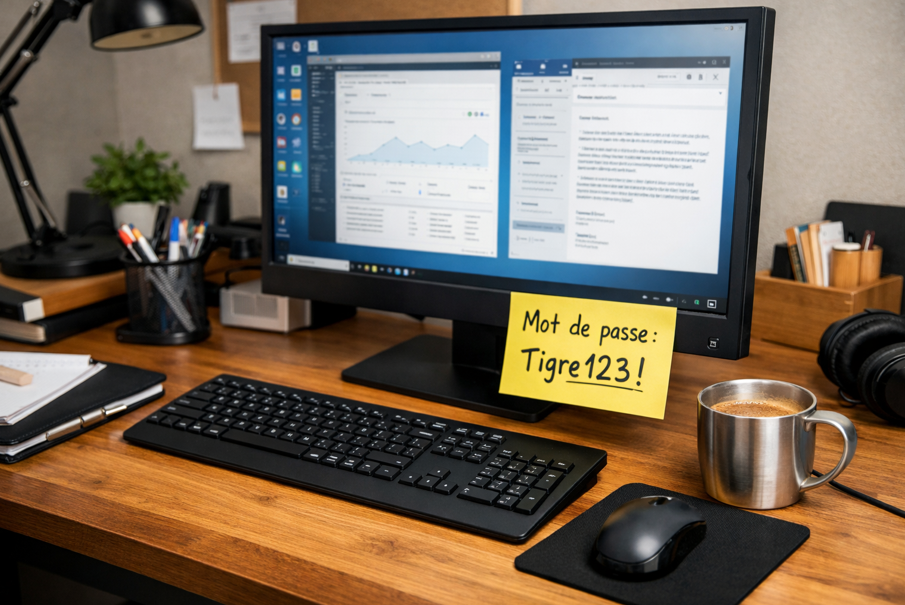
Mais pour autant, il n'est pas possible de surveiller humainement chaque collaborateur individuellement. Aussi il est important de disposer d'outils permettant de tracer ces activités et de différencier efficacement les activités potentiellement légitimes, des activités suspectes.
2.1.3 La détection des activités non autorisées
Par définition, une stratégie de sécurité et les bonnes pratiques associées sont un ensemble de règles permettant de minimiser les menaces
Detection
- Detect policy violations: A security policy is a set of rules and procedures created to help protect a company against security threats and ensure compliance. What is considered a violation would vary from company to company; examples include downloading pirated media files and sending confidential company files insecurely.
- Detect intrusions: Intrusions refer to unauthorized access to systems and networks. One scenario would be an attacker successfully exploiting our web application. Another would be a user visiting a malicious site and getting their computer infected.
Response
-
Support with the incident response: Once an incident is detected, certain steps are taken to respond to it. This response includes minimizing its impact and performing the root cause analysis of the incident. The team also helps the incident response team carry out these steps.
There are three pillars of a . With all these pillars, a team becomes mature and efficiently detects and responds to different incidents. These pillars are People, Process, and Technology.
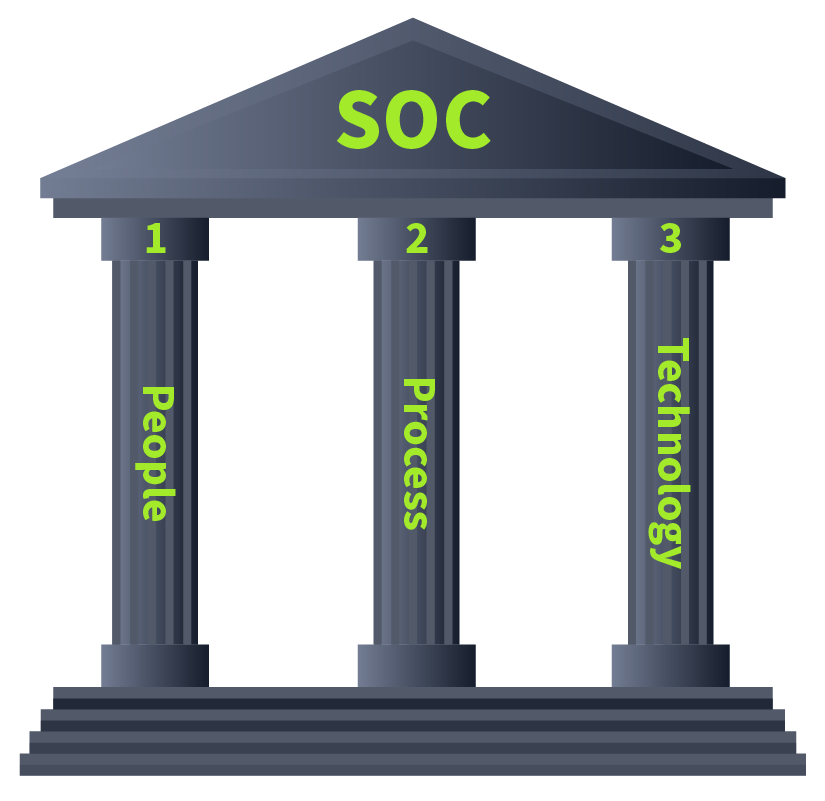
People, Process, and Technology coexist in a environment. A team of professional individuals working on state-of-the-art security tools in the presence of proper processes is what makes a mature environment.
In the upcoming tasks, we will discuss each of these pillars individually and examine how they are important parts of .
Regardless of the evolution of automating the majority of security tasks, the People in a will always be important. A security solution can generate numerous red flags in a environment, which can cause huge noise.
Imagine you are part of a fire brigade team and have centralized software where all the city’s fire alarms are integrated. Suppose you get many fire notifications at once, all for different places. When you get into those locations, your team finds out most of those were only triggered by excessive smoke from cooking. Eventually, all the efforts will be a waste of time and resources.
In a , with security solutions in place without human intervention, you'll end up focusing on more irrelevant issues. There are always the People who help the security solution to identify truly harmful activities and enable a prompt response.
The People are known as the team. This team has the following roles and responsibilities.
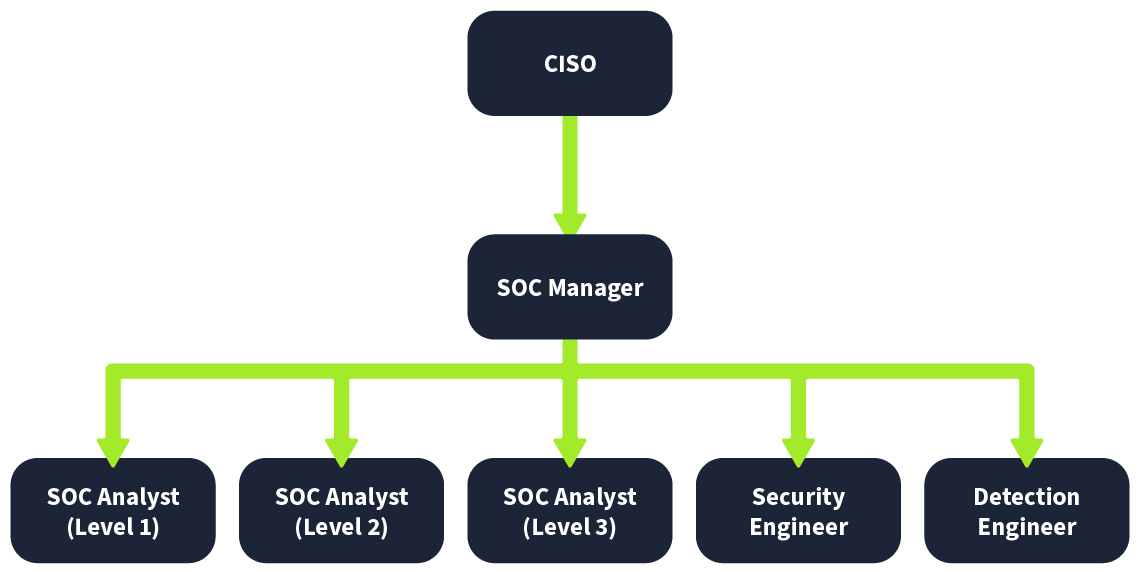
- Analyst (Level 1): Anything detected by the security solution would pass through these analysts first. These are the first responders to any detection. Level 1 Analysts perform basic alert triage to determine if a specific detection is harmful. They also report these detections through proper channels.
- Analyst (Level 2): While Level 1 does the first-level analysis, some detections may require deeper investigation. Level 2 Analysts help them dive deeper into the investigations and correlate the data from multiple data sources to perform a proper analysis.
- Analyst (Level 3): Level 3 Analysts are experienced professionals who proactively look for any threat indicators and support in the incident response activities. The critical severity detection reported by Level 1 and Level 2 Analysts are often security incidents that need detailed responses, including containment, eradication, and recovery. This is where Level 3 analysts’ experience comes in handy.
- Security Engineer: All analysts work on security solutions. These solutions need deployment and configuration. Security Engineers deploy and configure these security solutions to ensure their smooth operation.
- Detection Engineer: Security rules are the logic built behind security solutions to detect harmful activities. Level 2 and 3 Analysts often create these rules, while the team can sometimes also utilize the detection engineer role independently for this responsibility.
- Manager: The Manager manages the processes the team follows and provides support. The Manager also remains in contact with the organization’s CISO (Chief Information Security Officer) to provide him with updates on the team’s current security posture and efforts.
Note: The roles in the team can increase or decrease depending on the size and criticality of the organizations.
We discussed the roles and responsibilities of different individuals working in the team. Each role has its own Processes, just as we saw the role of Level 1 Analysts as the first responders to carry out alert triage and determine if it is harmful. Let’s discuss some important processes involved in a .
Alert Triage
The alert triage is the basis of the team. The first response to any alert is to perform the triage. The triage is focused on analyzing the specific alert. This determines the severity of the alert and helps us prioritize it. The alert triage is all about answering the 5 Ws. What are these 5 Ws?
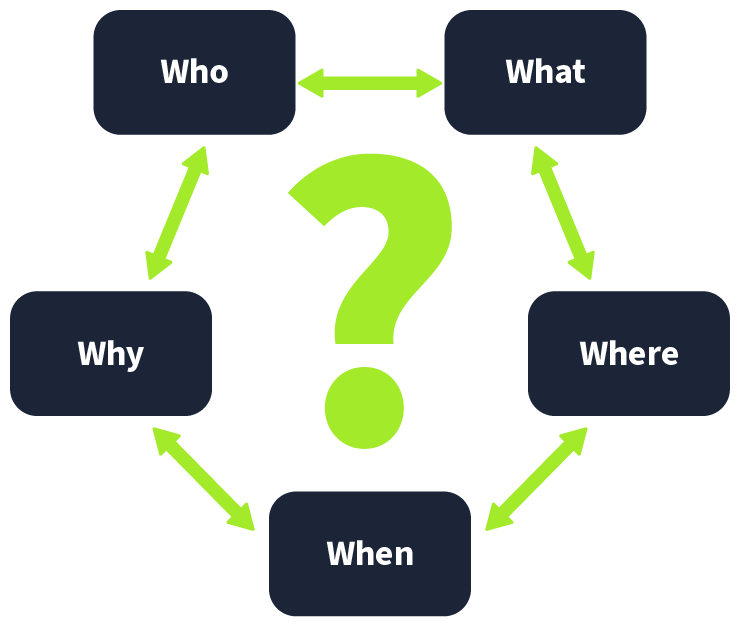
Following are some questions that need to be answered during the triage of an alert.
Alert: Malware detected on Host: GEORGE PC
| 5 Ws | Answers |
|---|---|
| What? | A malicious file was detected on one of the hosts inside the organization’s network. |
| When? | The file was detected at 13:20 on June 5, 2024. |
| Where? | The file was detected in the directory of the host: "GEORGE PC". |
| Who? | The file was detected for the user George. |
| Why? | After the investigation, it was found that the file was downloaded from a pirated software-selling website. The investigation with the user revealed that they downloaded the file as they wanted to use a software for free. |
Reporting
The detected harmful alerts need to be escalated to higher-level analysts for a timely response and resolution. These alerts are escalated as tickets and assigned to the relevant people. The report should discuss all the 5 Ws along with a thorough analysis, and screenshots should be used as evidence of the activity.
Incident Response and Forensics
Sometimes, the reported detections point to highly malicious activities that are critical. In these scenarios, high-level teams initiate an incident response. The incident response process is discussed in detail in the Incident Response room. A few times, a detailed forensics activity also needs to be performed. This forensic activity aims to determine the incident’s root cause by analyzing the artifacts from a system or network.
Having the right People and Processes in place would never be enough without security solutions for detection and response. The Technology portion in the pillars refers to the security solutions. These security solutions efficiently minimize the team's manual effort to detect and respond to threats.
An organization’s network consists of many devices and applications. As a security team, individually detecting and responding to threats in each device or application would require significant effort and resources. Security solutions centralize all the information of the devices or applications present in the network and automate the detection and response capabilities.
Let's get a brief understanding of some of these security solutions:
- : Security Information and Event Management () is a popular tool used in almost every environment. This tool collects logs from various network devices, referred to as log sources. Detection rules are configured in the solution, which contains logic to identify suspicious activity. The solution provides us with the detections after correlating them with multiple log sources and alerts us in case of a match with any of the rules. Modern solutions surpass this rule based detection analysis, providing us with user behavior analytics and threat intelligence capability. Machine learning algorithms support this to enhance the detection capabilities.
Note: The solution only provides the Detection capabilities in a environment.
- : Endpoint Detection and Response () provides the team with detailed real-time and historical visibility of the devices’ activities. It operates on the endpoint level and can carry out automated responses. has extensive detection capabilities for endpoints, allowing you to investigate them in detail and respond with a few clicks.
- : A functions purely for network security and acts as a barrier between your internal and external networks (such as the Internet). It monitors incoming and outgoing network traffic and filters any unauthorized traffic. The also has some detection rules deployed, which help us identify and block suspicious traffic before it reaches the internal network.
Several other security solutions play unique roles in a environment, such as Antivirus, , /, XDR, , and more. The decision on what Technology to deploy in the comes after careful consideration of the threat surface and the available resources in the organization.
This practical exercise uses People, Processes, and Technology and gives you a practical walkthrough of the role of a Level 1 Analyst in the team.
Click on the View Site button below to display the lab on the right side of the screen.
Scenario
You are the Level 1 Analyst of your organization’s team. You receive an alert that a port scanning activity has been observed on one of the hosts in the network. You have access to the solution, where you can see all the associated logs for this alert. You are tasked to view the logs individually and answer the question to the 5 Ws given below.
Note: The team notified the team that they were running a port scan activity inside the network from the host: 10.0.0.8